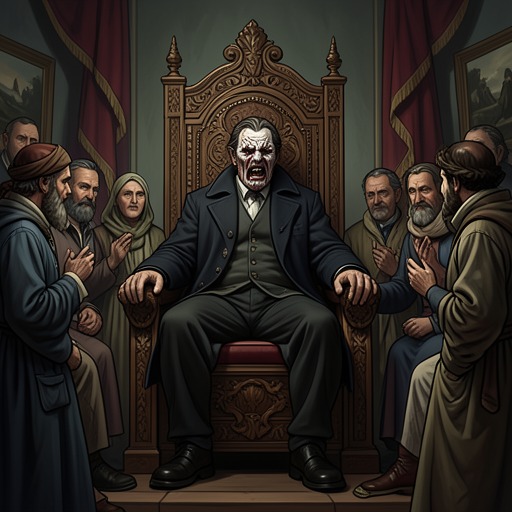
Hildred Castaigne—Louis Castaigne
The King in YellowHildred Castaigne—Louis Castaigne is the central hostile kinship in Hildred Castaigne’s political and psychological collapse. The relationship begins within a family genealogy that places Louis and Hildred inside the imagined succession of the Imperial Dynasty of America, but it hardens when Hildred claims the crown for himself. Louis’s military rank, his apparent love for Constance Hawberk, and his refusal to disappear from public life become, in Hildred’s eyes, evidence that a cousin has become a rival. What might have remained a strained family connection is recast as a dynastic war in which marriage, exile, and death are treated as instruments of succession.
Family Position and Early Tension
Hildred’s understanding of Louis is inseparable from the manuscript entitled “THE IMPERIAL DYNASTY OF AMERICA.” He has read the worn pages so often that he knows its genealogy by heart, from the opening reference to Carcosa, the Hyades, Hastur, and Aldebaran to the recorded birth of “Castaigne, Louis de Calvados, born December 19th, 1877.” He dwells particularly on the line naming “Hildred de Calvados, only son of Hildred Castaigne and Edythe Landes Castaigne, first in succession,” treating the manuscript not as imaginative writing but as documentary proof of hereditary right. Louis therefore appears within the same family structure that establishes Hildred’s supposed precedence, and the cousinship carries political meaning from the outset.
The family question becomes explicit when Mr. Wilde asks how Constance Hawberk and Louis get along. Hildred replies that Dr. John Archer can wait because it is time for him to see his cousin Louis. Mr. Wilde repeats that it is time, and the repetition gives their meeting the character of an appointed political act rather than an ordinary family visit. The relationship is already being organized around inspection, judgment, and succession: Louis is not merely a relative to be greeted but a person whose position must be assessed.
Louis as Public Rival
Louis’s appearance in uniform intensifies Hildred’s divided response. Military music announces the return of the twentieth dragoon regiment from manoeuvres in Westchester County to its new barracks on East Washington Square. Hildred admires the regiment’s pale blue jackets, tight-fitting uniforms, jaunty busbys, white riding breeches, lances, yellow and white pennons, sabres, spurs, and carbines. He sees Louis riding with his squadron and calls him as handsome an officer as he has ever seen. The admiration is real, but it does not soften the rivalry; Louis’s elegance, authority, and visibility make him more threatening because they give the cousin an independent public stature.
Louis turns and looks directly toward Hawberk’s shop as the regiment passes. Hildred interprets the gesture through Constance Hawberk, thinking that she must have been at the window. The scene therefore binds together the two sources of Louis’s power in Hildred’s imagination: the cousin is both a soldier and a prospective bridegroom. His public role and private attachment seem to confirm that he occupies a place in the world that Hildred believes should belong to himself.
The conflict is sharpened when Louis tells Hildred that he is going to be married, specifically to “the sweetest girl on earth.” Hildred experiences the announcement as a physical shock and keeps his eyes on Louis’s face while concealing his reaction. The marriage plan converts jealousy into dynastic urgency. Louis’s intended union with Constance is not treated by Hildred as a private choice; it threatens to connect Louis with the Hawberk family and, in Hildred’s later formulation, even to bring England into the succession question.
The Succession Dispute
Hildred’s claim rests on a private mythology that he and Mr. Wilde present to Osgood Oswald Vance as historical truth. Mr. Wilde reads the entire history of the Imperial Dynasty of America and explains its supposed lineages through heraldic volumes, invoking Carcosa, Hastur, Aldebaran, the Hyades, Cassilda, Camilla, Demhe, and the Lake of Hali. He then leads Vance through the family ramifications until he reaches the story of the Last King and identifies Hildred as “The cousin of the King!” Hildred’s relationship with Louis is consequently placed inside an immense invented genealogy whose scale makes ordinary family affection appear subordinate to imperial destiny.
Hildred then states the practical consequences of that genealogy. He insists that he alone is worthy of the crown and that Louis must be exiled or die. Louis must not marry even if he renounces his claims, and above all must not marry the daughter of the Marquis of Avonshire, because such a marriage would bring England into the question. Hildred’s language reduces Louis’s freedom to a succession problem: Louis may either surrender his place and accept exile or remain a living danger. Kinship has not disappeared, but it has been stripped of reciprocity and converted into a legal and military obstacle.
The Yellow Sign gives this imagined authority an apparatus of coercion. Hildred shows Vance a list of thousands of names and claims that every person listed has received the Yellow Sign, which no living human being dares disregard. He declares that the city, the state, and the whole land are ready to rise before the Pallid Mask. In this framework, Louis is not opposed only by one deluded cousin; Hildred imagines an entire state waiting to enforce his interpretation of hereditary right. The family conflict expands into a projected national uprising.
Direct Confrontation and Threats
Hildred later tells Louis that Dr. John Archer discovered the secret of the Imperial Succession and tried to deprive Hildred of his right by alleging that a fall from his horse four years earlier had left him mentally deficient. Hildred claims that Dr. John Archer restrained him in his own house in an effort either to drive him insane or poison him, and he announces that his visit to the doctor the previous night was final. He immediately identifies Louis, Mr. Hawberk, and Constance Hawberk as the remaining people to be interviewed in the interests of Mr. Wilde and himself. The phrase turns family members into entries on an executioner’s schedule.
Louis turns pale but initially remains still. Hildred, however, abandons any appearance of negotiation. He tells Louis that Louis cannot marry and that Hildred forbids the marriage. He offers exile as a reward for renouncing the crown, but declares that refusal will mean death. The relationship has reached a state in which Hildred speaks as sovereign, judge, and executioner, while Louis is forced into the position of subject and condemned rival.
The physical confrontation makes the hostility unmistakable. Hildred draws a long knife and blocks Louis’s way. He tells him that Dr. John Archer will be found in the cellar with his throat open, refers to Osgood Oswald Vance and the order bearing Hildred’s signature, and asserts that Louis cannot keep him from empire over the habitable earth. His claim that he was born the cousin of a king but will become King expresses the relationship’s governing reversal: the shared blood that once establishes connection now supplies Hildred with the language of superiority.
Collapse of Kinship and Aftermath
When Osgood Oswald Vance runs into the Lethal Temple and enters the death chamber, Hildred recognizes him and concludes that Hawberk and Constance are no longer in his way. He tells Louis that Louis has ceased to be a menace, that Louis will never marry Constance, and that any later marriage during exile will bring Hildred to him as Hildred came to Dr. John Archer. Mr. Wilde is assigned to take charge of Louis the next day. Even at the moment when he claims to have neutralized Louis, Hildred continues to define the cousin through surveillance, exile, and threatened murder.
Louis’s response is flight and pursuit rather than acceptance. He drops his belt and sabre and follows Hildred through the streets. Hildred reaches the doorway beneath Hawberk’s sign and escapes upstairs, while Louis remains below, hammering and shouting at the door as though the dead could still be awakened. The scene gives the antagonistic relationship a final spatial form: Hildred climbs toward the symbolic world of crown and conspiracy, while Louis is left at the shop associated with Constance and the family life Hildred has tried to destroy.
Hildred then enters Mr. Wilde’s rooms, takes the diadem from its case, puts on the white silk robe embroidered with the Yellow Sign, and places the crown on his head. He experiences himself as King through his supposed right in Hastur and his supposed knowledge of the Hyades and the Lake of Hali. Yet the triumph immediately collapses. In the darkness he kills the cat, discovers Mr. Wilde with his throat torn open, and watches him die. The death removes the organizer who had helped convert Hildred’s family fantasy into a political program. Louis survives as the cousin who has been threatened, displaced, and pursued, while Hildred is left alone with the crown and the wreckage of the relationship that his ambition has turned into war.
Narrative Function and Significance
The Hildred Castaigne—Louis Castaigne relationship dramatizes the conversion of kinship into paranoid rivalry. Hildred cannot hold Louis as both beloved family and competitor; he divides him into the threatening figure who must be eliminated and the subordinate relative who may be permitted exile. The military parade, the marriage announcement, the genealogical manuscript, the Yellow Sign, and the knife each intensify the same movement from recognition to possession and from possession to violence.
The relationship also exposes the instability of Hildred’s authority. He repeatedly speaks in the language of law, succession, and imperial command, yet his power depends on Mr. Wilde’s explanations, the manuscript’s genealogy, the threatened list of names, and his own escalating acts of violence. Louis’s calmness, pallor, and eventual pursuit contrast with Hildred’s bodily surges of fury and triumph. Their conflict is therefore not a balanced contest between two political claimants but the story of one cousin imposing an increasingly absolute interpretation on the other. By the time Hildred crowns himself, the family bond has become evidence in a delusional case, and Louis’s continued existence is treated as an accusation against Hildred’s right to rule.